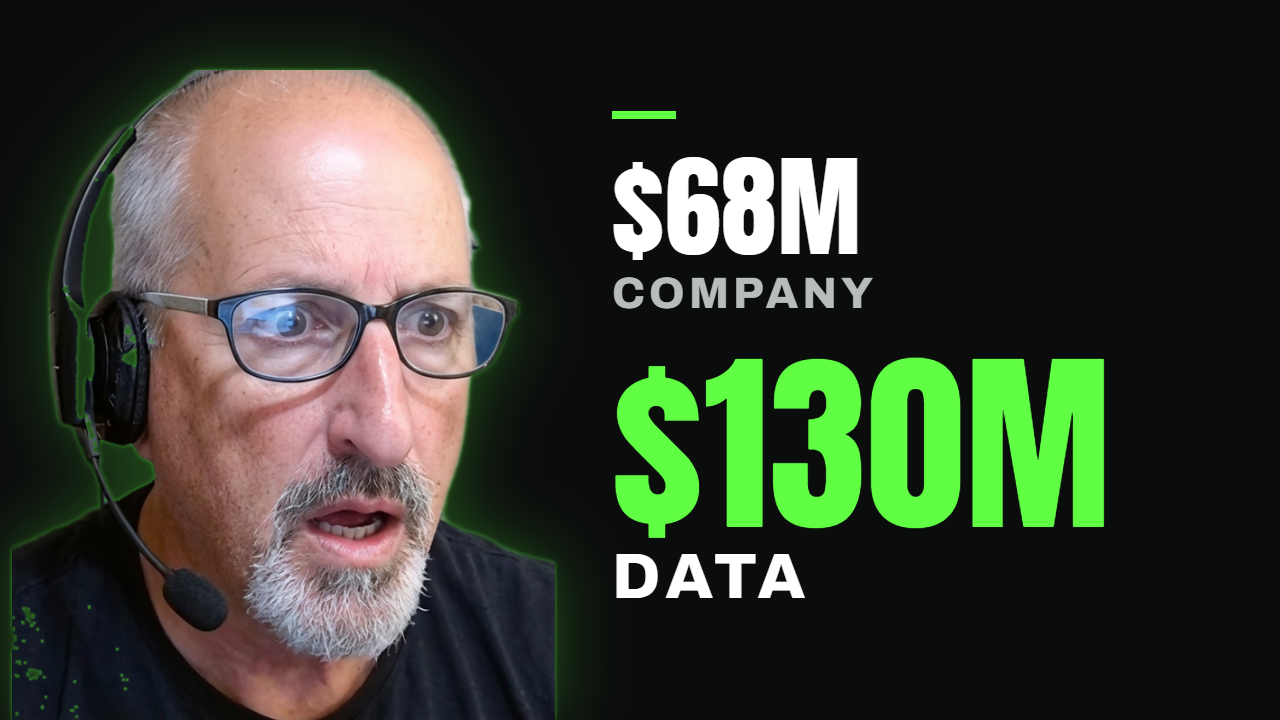
When your data is worth more than your company
How Chris Schuring turned corporate archives into revenue, why brands matter in AI, and the Spirit Airlines cautionary tale.
“Their data was worth $130 million while the company was valued at $68 million.” — Chris Schuring
Chris Schuring opened with a single, counterintuitive fact and built the rest of the conversation around it: data no longer lives as an IT cost. For many companies it is the asset that decides whether they survive, sell, or vanish.
Why data is the new balance‑sheet asset
Chris remembers when data was always a liability: racks of servers, headcount, licences. Now firms sit on years or decades of customer interactions, parts records, transaction logs — quietly accruing value they don’t recognize. He gives two concrete examples that make the point unmistakable:
A client with an enterprise valuation of $68M whose data alone appraised at $130M.
Spirit Airlines selling its data to Google for roughly $10M — while Chris’s team estimated that same data was worth about $1.5B.
Those gaps matter. When data is properly valued and stewarded it becomes “newfound money”: 100% revenue that can be used for M&A, debt relief, or operational investment. The work at DataRevenue is not just appraisal; it’s stewardship — turning an appraisal into recurring revenue (licensing, syndication, aggregation) or equity value.
The practical playbook Chris uses
Chris and his co‑founders are financial engineers as much as technologists. They don’t sell vague analytics; they place data on the balance sheet and then use standard finance tools to unlock it. The process he describes is repeated across industries (real estate, pharma, manufacturing):
Inventory and value the datasets.
Design legal/contract frameworks (de‑identification where needed).
Package or aggregate data for buyers or partners.
Place that revenue onto the company’s books or use it as collateral for deals.
One tangible outcome he shared: DataRevenue now has over $10 billion in data valuation under stewardship. That’s not marketing hyperbole; it’s the scale they use to negotiate real financial outcomes with clients.
AI, brands, and who controls the models
Charles and Chris threaded AI throughout the conversation — not as a buzzword, but as the engine that raises the value of curated, reliable data. A few practical points from their exchange:
Models get better when the data behind them is richer and cleaner. Bigger brand platforms will have less “hallucination” because their datasets are deeper.
The brand battle matters: the dominant AI platforms and the data they control will shape which business models win. Expect consolidation — “big fish eat smaller fish” — and a handful of platforms to emerge.
Small companies can still win by packaging specialty data, or by pooling SMB datasets to create aggregated products that larger buyers value.
Charles’s mechanic story — wiring a car per a diagram that was printed upside down — is a useful metaphor: AI pulls from internet sources that can be wrong, misformatted, or culturally specific. The human in the loop still matters. As Chris put it:
“Ask the right question. If you ask better questions, you get better results.” — Chris Schuring
That’s about prompts, yes, but also about ownership and provenance: if your brand and your data produce authoritative answers, you become the daemon that cleans the cesspool Eric Schmidt feared.
Y2K, hardware bugs, and the new kinds of surprises
Both hosts leaned on historical analogies to explain risk. Charles called this “AIY2K”: years from now we may discover assumptions baked into early models that cause large business mistakes. Chris compared subtle failures — an invisible space character causing a system crash, or a blueprint read upside down — to the kinds of unanticipated errors AI can introduce. The takeaway: maintain technical stewardship, audit models, and preserve human review for high‑risk outputs.
The small business angle and one concrete next step
This isn’t only for enterprises. Chris explained how four SMBs can aggregate data into a single pool, monetize it, and share the upside. The mechanics differ, but the core idea is the same: data is tradeable, licensable, and financeable.
If you want the simplest next move Charles and Chris recommend: start the conversation. Inventory one dataset you already own (customer list, service logs, parts history), estimate what buyers would value about it, and ask a vendor or advisor what stewardship would look like.
If you’d rather listen, the full conversation between Charles Davis and Chris Schuring walks through the valuation examples, the stewardship plumbing, and the precise questions to start asking today.